A Different Beginning: Living Between Worlds
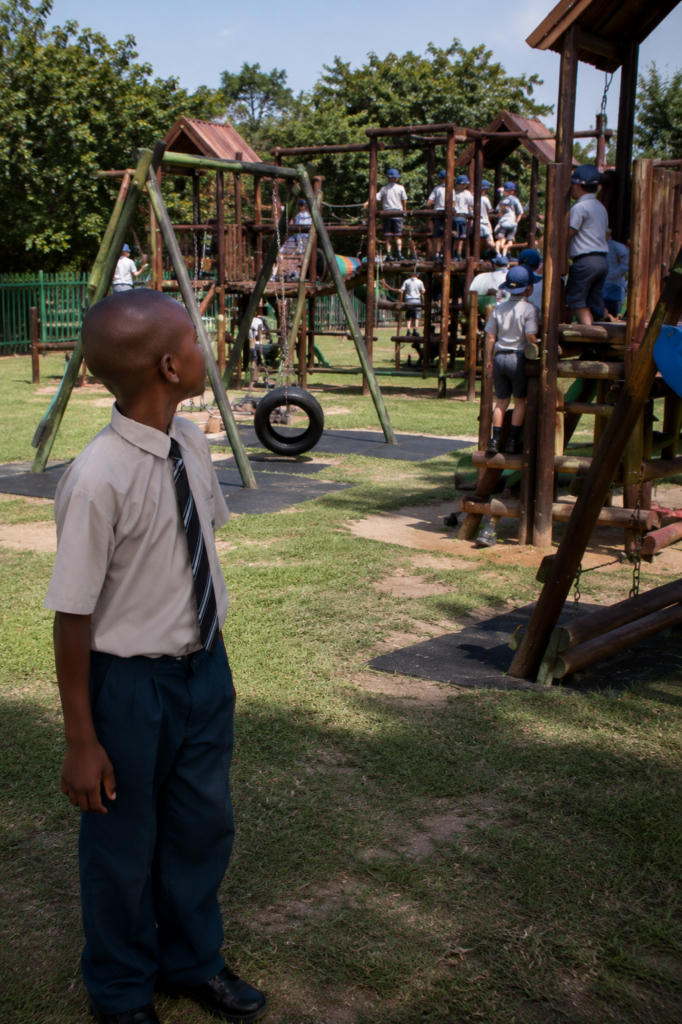
Living Between Worlds takes me back to Foundation Phase.
Like an old married couple rewinding a VCR just to relive the good old days.
Foundation Phase was my first introduction to this entirely new world called private school.
The first thing that caught my attention wasn’t the classrooms.
It was the playground.
The jungle gyms.
Not the watered-down plastic playgrounds children grow up with today.
The real jungle gyms.
The ones my generation grew up on.
Swings.
Climbing frames.
Slides.
All kinds of big-boy toys.
As a young boy who had just arrived from a local public school, I remember thinking:
“We can actually play on these?”
The Foundation Phase playground felt like a different world entirely.
The Teacher Who Changed Learning
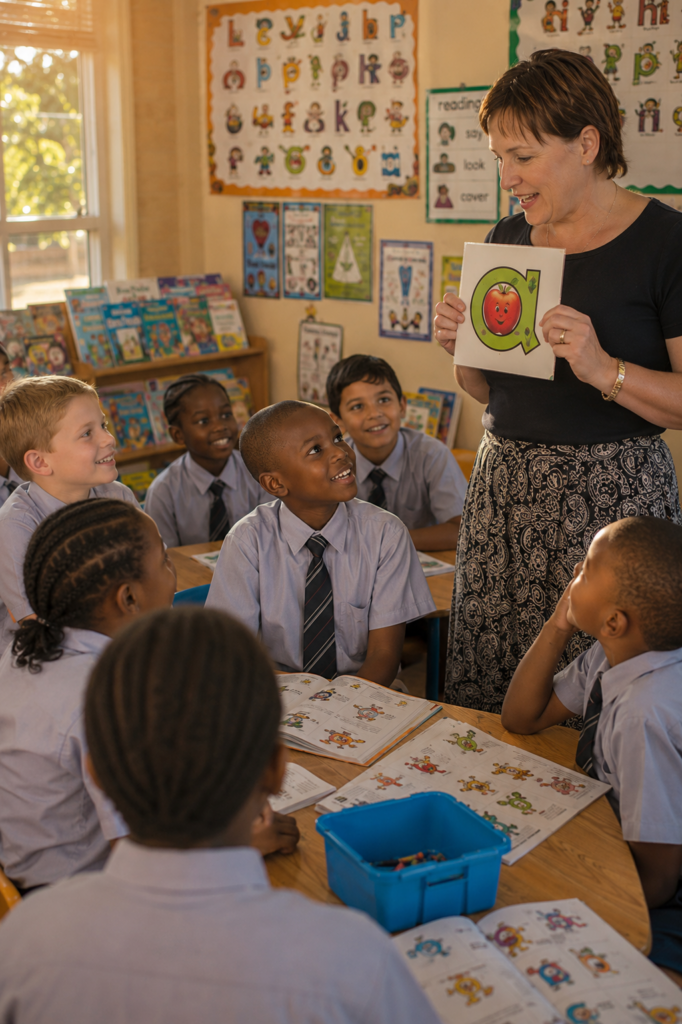
My Grade 1 class is something I still remember vividly.
Especially my teacher, Mrs Johnston.
In my journey through public school, learning never really captured my attention.
I was more interested in friends.
Playing.
Exploring.
Having fun.
But Mrs Johnston exposed the first crack.
Not in a bad way.
In a way that changed everything.
What made her different wasn’t the classroom.
It wasn’t the school.
It was the system she used to teach us.
Mrs Johnston understood something I wouldn’t understand until much later.
Children don’t learn through information.
They learn through imagination.
A wasn’t simply A.
A was Annie Apple.
B wasn’t simply B.
B was Bouncy Ben.
And my personal favourite was M for Munching Mike.
Suddenly the alphabet wasn’t a list of letters anymore.
It was a collection of characters.
Each with their own stories.
Their own personalities.
Their own little worlds.
Without realising it, Mrs Johnston had turned learning into storytelling.
And storytelling into learning.
For the first time in my life, education felt fun.
For the first time, I wanted to pay attention.
Looking back now, I think Mrs Johnston taught me something much bigger than the alphabet.
She taught me that creativity can transform something boring into something unforgettable.
And maybe…
that lesson stayed with me far longer than the ABCs ever did.
The System Behind The Classroom
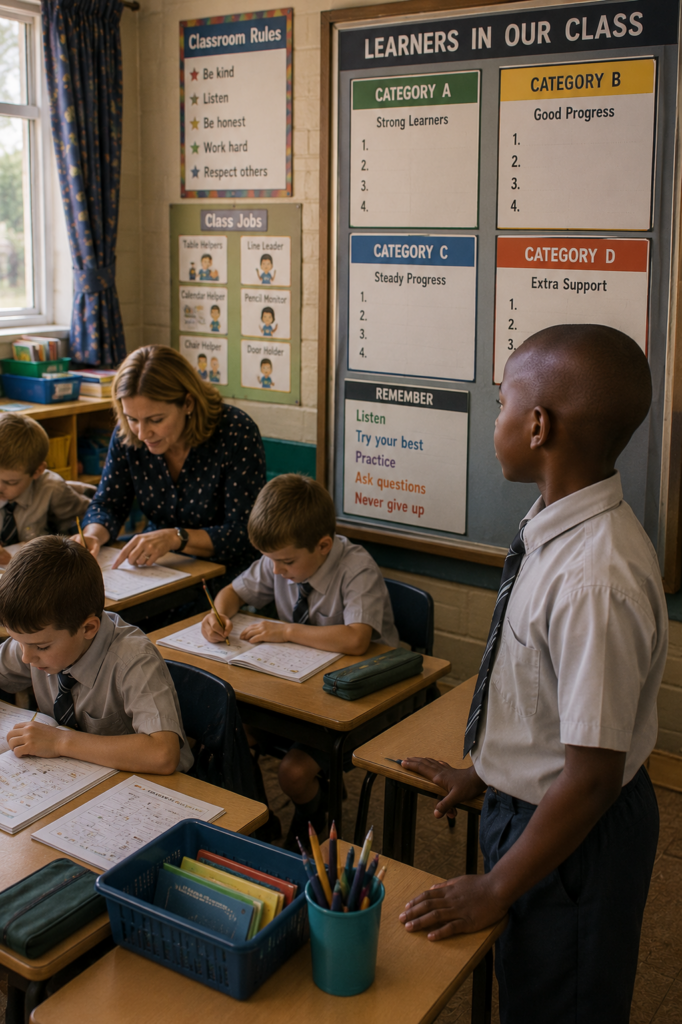
As time went on, I started noticing another system hiding in plain sight.
A system that, looking back now, was surprisingly effective.
Categorising students.
Today, some people might see that as harsh.
Others might see it as limiting.
But for me, it worked.
Because instead of constantly focusing on what I couldn’t do, it gave me a clear picture of where I stood and what I needed to improve.
The system was simple.
The strongest learners were placed in Category A.
The next group sat in Category B.
Above-average learners were placed in Category C.
And learners who needed more support were placed in Category D.
I found myself in Category C.
Placement wasn’t based on popularity.
It wasn’t random.
It was based on how quickly you learned, how well you could read, understand numbers, complete tasks and absorb information.
Because our classes were small, usually between ten and thirteen learners, the teachers had enough time to know each of us individually.
They knew our strengths.
They knew our weaknesses.
They knew where we were progressing.
And where we were struggling.
Looking back now, I realise how much attention that gave each learner.
You couldn’t disappear inside a classroom like you can in a class of forty students.
The interesting thing was that your position wasn’t permanent.
It worked almost like the workplace.
If you wanted to move up, you had to earn it.
If you improved, you could move from D to C.
From C to B.
From B to A.
But if you became lazy and stopped applying yourself, you could just as easily move backwards.
At the time, it felt like a game.
A challenge.
A ladder.
And for the first time in my life, learning wasn’t simply something happening to me.
It was something I could actively improve at.
Looking back now…
I think that was another lesson private school quietly taught me.
Progress isn’t something you’re given.
It’s something you climb toward.
The Private School Curse: Living Between Worlds
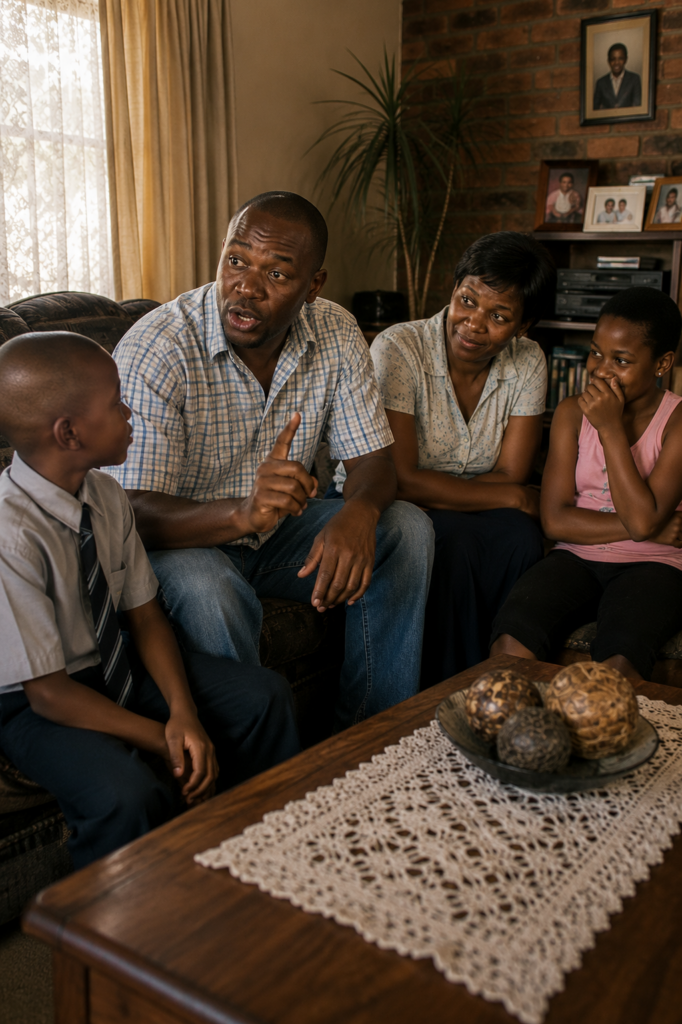
The private school curse was indeed contagious.
Not in a bad way.
Not in a manipulative way.
But it carried its own influence.
Not only over us as students.
Over our parents too.
The curse?
Speaking English.
Only English.
My conscious mind hated that rule.
And somehow the infection spread all the way into our household.
Especially to the man of the house.
My father.
One day he announced a brand-new family law.
“From now on, we are only speaking English at home.”
Ironically, he announced this in Sesotho.
As a child, I took the rule seriously.
At school, speaking anything other than English felt almost illegal.
Like there were language police hiding around every corner waiting to catch you.
Now the same law had followed me home.
Come on.
Give me a break.
The funny thing is that after about five minutes of trying to follow this new household policy, I completely forgot about it.
Instinct took over.
Life carried on.
And like most children, I continued believing I was fully in control of my actions while being completely unaware of how automatic most of my behaviour really was.
Then something happened.
Only a few minutes after introducing the new English-only law, my father broke it himself.
The very same law he had just passed.
And that was when another small crack appeared.
Not a crack in my respect for him.
A crack in the image I had of adults.
Because until then, parents felt almost godlike.
Certain.
Unquestionable.
Always correct.
But in that moment I saw something different.
I saw a human being.
A person trying his best.
A person capable of making rules and breaking them moments later.
Just like everyone else.
Of course, I kept quiet.
Correcting your parents wasn’t exactly encouraged in our household.
And even as a child I understood that some truths were better left unsaid.
But the observation stayed with me.
Looking back now…
I think moments like that slowly taught me something important.
The older I get, the more I realise that moments like these were never really about language. They were about watching my father navigate life, responsibility and identity in real time… explored deeper in What My Father Passed Down.
Parents are not perfect people raising imperfect children.
They are imperfect people trying to figure life out while raising children at the same time.
And maybe that’s what makes them human.
Friendships Across Distance: Living Between Worlds
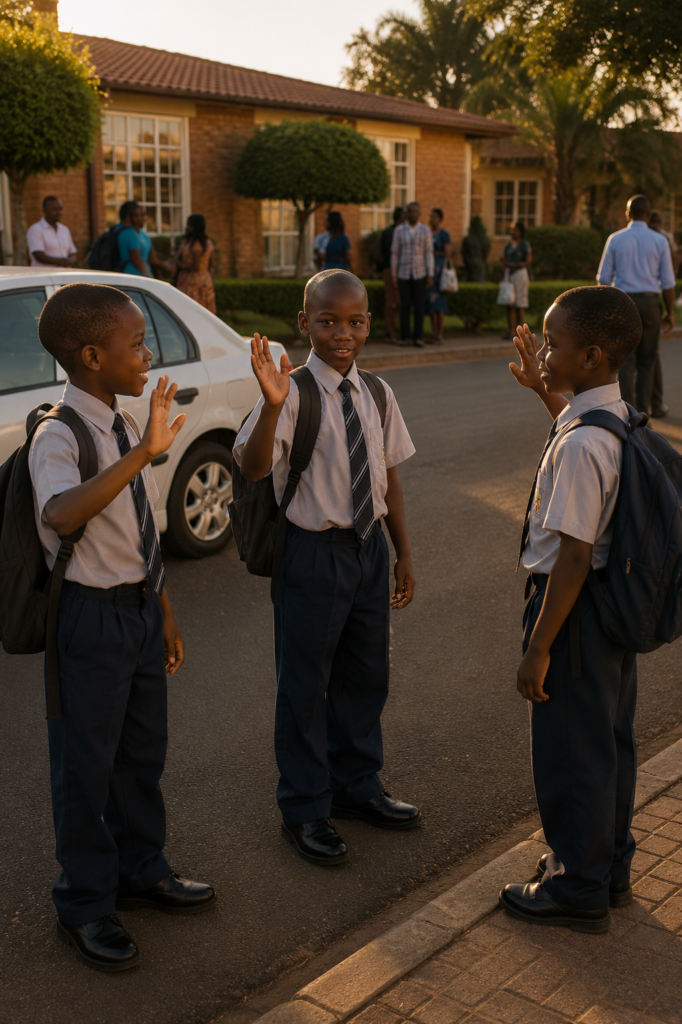
My private school friendships were very similar to the friendships I had back home.
Living Between Worlds…
The biggest difference was distance.
Back in Orkney, my friends lived a few minutes away.
At private school, friendships mostly existed during break time and between classes.
When school ended, everyone disappeared back into their own worlds.
I had two close friends.
One from Klerksdorp.
One from Kanana.
That meant visiting each other wasn’t something that happened after school.
It had to be planned.
Usually the system worked like this:
My mother would phone my friend’s mother and arrange a weekend beforehand.
Then after school on Friday, I would pack a small bag and get dropped off for the weekend.
Sometimes I went to them.
Sometimes they came to us.
That was how our friendships survived outside the classroom.
Looking back now, many of those early friendships belonged to the same chapter of childhood explored in The First Battle, where friendship, imagination and belonging quietly shaped the way I saw the world.
The Worlds Beyond The Classroom
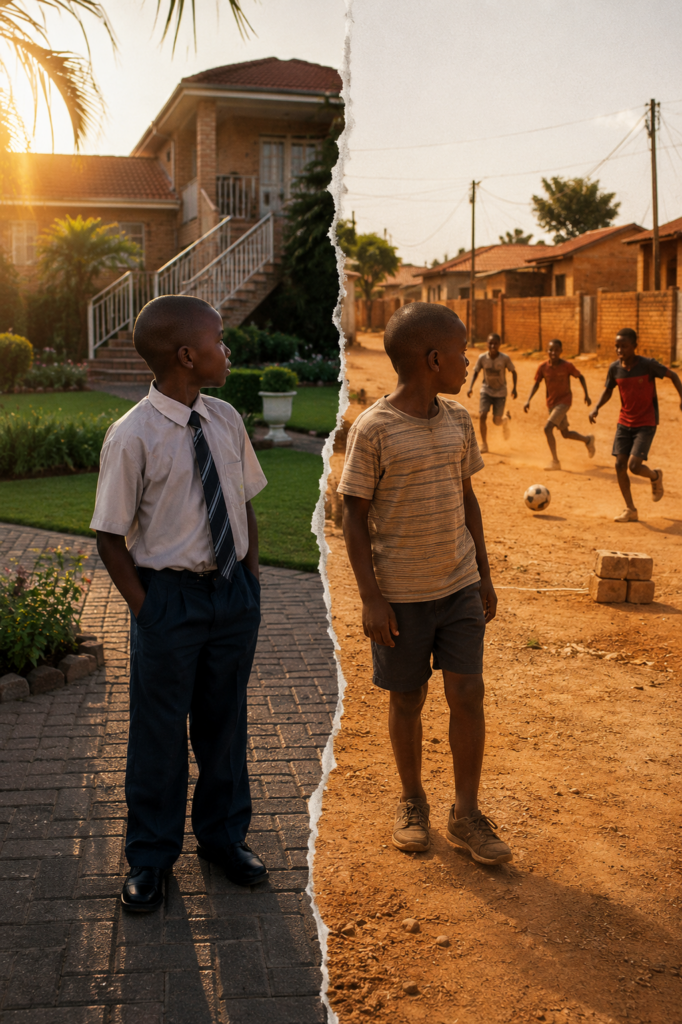
Looking back now, those weekend visits were probably my first real experience of living between worlds.
One friend exposed me to a completely different lifestyle.
His house was huge.
At least huge through the eyes of a young boy.
The first thing that caught my attention was the staircase.
My word.
The moment I saw it, my imagination went wild.
Not because I was thinking about money.
Not because I was thinking about success.
I was still a Foundation Phase child.
All I could think about was how amazing it would be to swing from the top and glide all the way down.
The adults constantly warned us it was dangerous.
They said serious injuries could happen.
But something inside me liked risk.
I wanted to try it anyway.
My other friend exposed me to something completely different.
Weekends in Kanana.
There we didn’t spend all our time inside the house.
We played in the streets.
Met other children.
Played soccer using bricks as goalposts.
And for the first time I learned how to play snooker.
It was a completely different environment.
A completely different experience.
Yet somehow it felt just as normal.
Looking back now, I realise that moving between different environments was shaping more than my experiences. Each world quietly rewarded a different version of who I could become. Long before I understood it, I was already learning which parts of myself were accepted, encouraged and recognised by others… explored deeper in The Version They Needed.
Looking back now, I didn’t know how important that familiarity would eventually become. Moving between different environments had already taught me that the same child could feel at home in completely different worlds. Years later, that ability would follow me into streets and spaces that operated by rules very different from the ones I had learned at home and at private school. What first felt unfamiliar would not always remain unfamiliar… explored deeper in The Streets I Grew Up In.
Looking back now, those experiences were part of a much bigger environment that had already been shaping me for years… explored deeper in Growing Up In Orkney.
As we moved through Grade 1, Grade 2 and Grade 3, those visits quietly expanded my view of the world.
But if I’m being honest…
most weekends had another priority.
Cartoon Network.
Ben 10.
Back-to-back episodes.
No chance I was missing that.
While my friend disappeared outside to play with the other children, I often stayed behind glued to the television.
He wasn’t interested in Ben 10.
I was.
So while he was outside building memories in the streets…
I was inside saving the world with the Omnitrix.
The Edge Of Something New
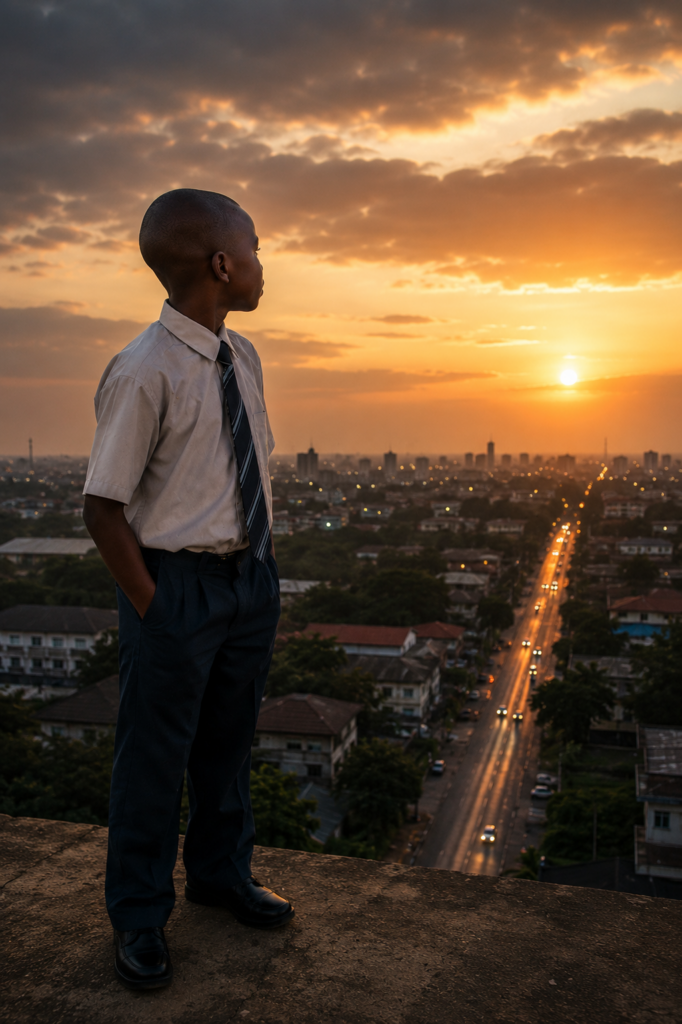
Living Between Worlds: looking back now…
those years felt simple.
Playgrounds.
Sleepovers.
Cartoons.
Friends.
Small adventures that felt much bigger than they really were.
At the time, I thought that was all life was.
School during the week.
Friends on the weekend.
Cartoons in between.
Simple.
Predictable.
Safe.
But life was already moving underneath the surface.
Quietly.
Without asking for permission.
Without announcing itself.
The strange thing about childhood is that you never realise a chapter is ending while you’re inside it.
You only realise later.
Years later.
Looking back.
And seeing the pieces connect.
At the time, I thought I was simply learning how to navigate private school.
What I didn’t realise was that private school was only one part of the story.
Something else was forming.
Something I couldn’t see yet.
New environments.
New pressures.
New expectations.
New questions.
The worlds around me were changing.
And without realising it…
so was I.
Looking back now, I realise one of those changing worlds would begin with something much simpler than I could have imagined. I was getting older, spending less time inside the childhood I already knew and becoming more curious about where I belonged outside it. I wasn’t searching for trouble. I wasn’t searching for anything called the dark. At first… I was simply a boy trying to make friends in a community where everyone else already seemed to know each other… explored deeper in Before I Knew It Was the Dark.
Looking back now, I realise those changing worlds were shaping more than my environment. They were quietly shaping the future I imagined for myself. A future that once felt close enough to touch before distance, routine and time slowly took over… explored deeper in The Promise You Forgot You Made.
Looking back now…
I think that’s where Living Between Worlds truly began.