
Introduction: What Your Bank Doesn’t Teach You
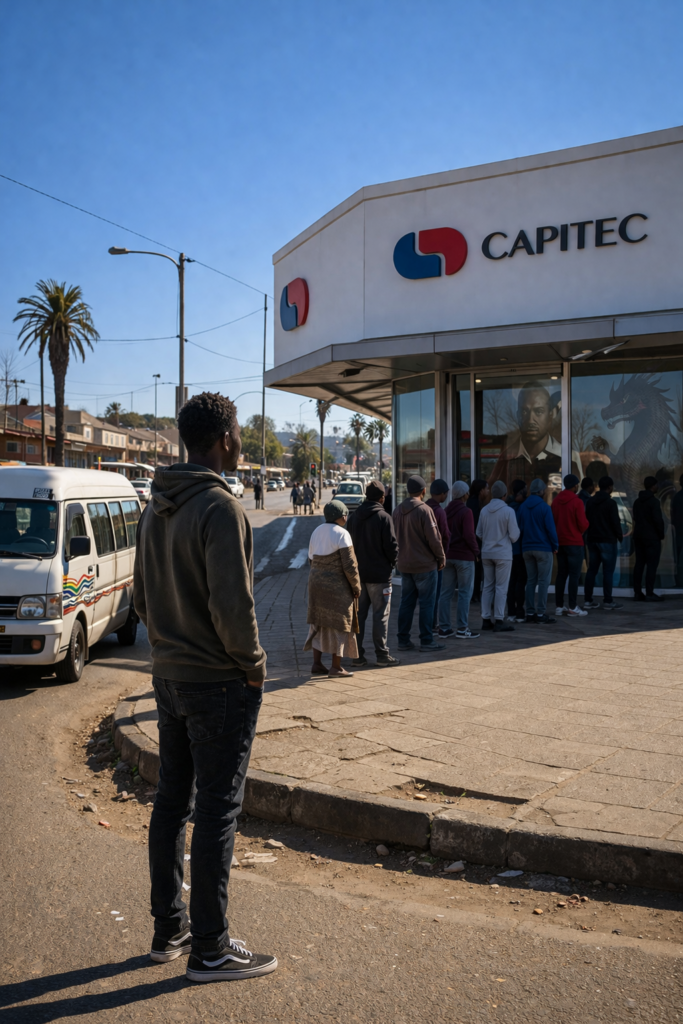
What your bank doesn’t teach you is something simple… yet deeply sophisticated.
As I mentioned in my article We Don’t Have a Money Problem: We Have a Thinking Problem, South Africa… the motherland… has one of the most sophisticated banking systems in the world, shaped by strong regulatory and legal frameworks.
But most of us don’t think about that.
Not when we’re standing in queues at month-end…
waiting to send money to family…
or withdrawing cash for a braai while the Soweto giants are playing.
It’s part of life.
Normal.
Not because we don’t care…
but because no one ever showed us.
And when something becomes normal…
we stop questioning it.
We stop observing it.
We stop asking how it actually works.
We just participate.
And over time…
that participation turns into a pattern.
A pattern we repeat…
without awareness.
And anything repeated without awareness…
eventually feels like reality.
Even when it’s not working for you.
The Bank in Your Pocket: What Your Bank Doesn’t Teach You

What your bank doesn’t teach you is not only found in the system you carry in your pocket…
your bank card, your app, or even platforms like Capitec.
It also lives in how you relate to money… internally.
That relationship was not created by the bank.
It was shaped long before your first salary.
It was shaped at home.
In your environment.
In your community.
You see it in the uncle who still prefers physical cash… the Madiba notes…
Not because he lacks intelligence.
But because he doesn’t fully trust the system.
And that distrust didn’t appear randomly.
It was built over time.
Through stories heard in taxis…
conversations between neighbours…
real experiences of people losing money.
Like the woman who saved for years…
trying to send Bongi to university…
only to lose it through a scam.
That moment doesn’t just affect her.
It travels.
It becomes a warning.
A story repeated.
A fear adopted by others who were never there.
So instead of identifying the real issue…
that the system requires awareness and responsibility…
the system itself gets blamed.
And that’s where misunderstanding begins.
Because the system is not the problem.
The relationship with the system is.
Or maybe…
the sophistication of modern banking has not fully settled into what I call the second mind.
That deeper layer…
where behaviour becomes automatic.
Where decisions are no longer conscious…
but inherited.
You Were Taught to Use Money

School teaches us structure, discipline, and how to think.
And that matters.
Because without that foundation, many of us wouldn’t even be able to function in society.
We learn how to read.
How to write.
How to follow systems.
At home, we learn how to survive with money.
How to stretch it.
How to prioritise.
How to make a plan when things are tight.
But very few of us are ever shown how money actually works.
No one explains:
Where money comes from.
How banks generate money.
If you want to understand how financial systems evolved into what we see today… start here: Banking Through the Ages — Part 1
Why money behaves the way it does.
Why debt feels heavy… even before it becomes a problem.
So we grow up knowing how to use money…
but not how to understand it.
And that gap…
is where confusion lives.
Because when you use something without understanding it…
you will always react to it.
Never control it.
And reaction…
is what keeps most people stuck.
Not because they are incapable…
but because they are operating without clarity.
What Your Bank Doesn’t Teach You About Your Money
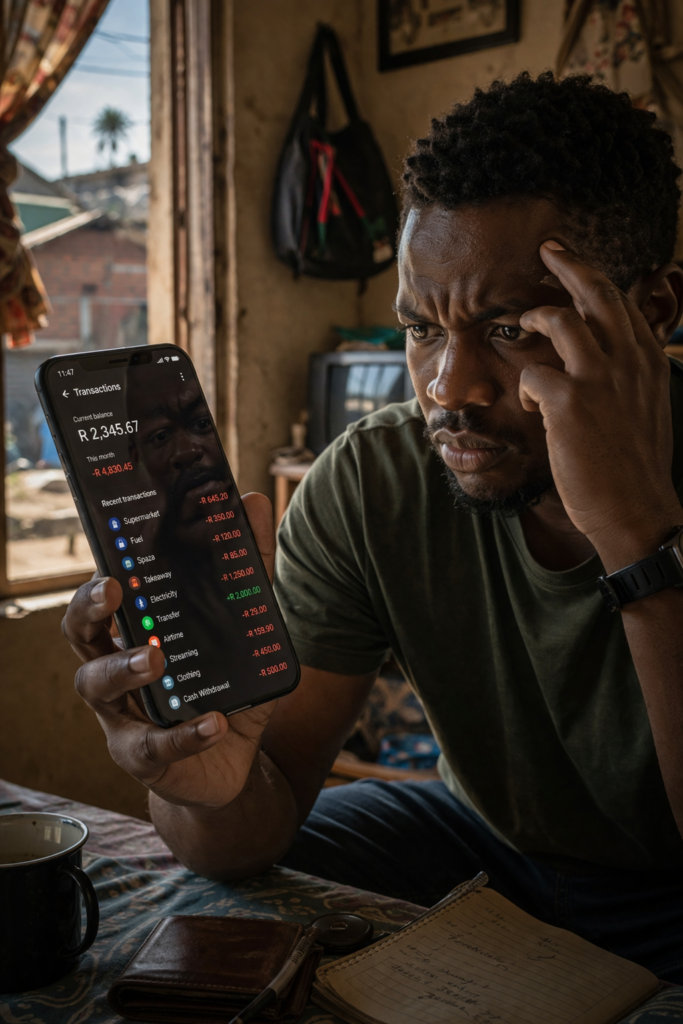
What your bank doesn’t teach you is already sitting inside your daily life.
Inside your banking app… there is a feature most people ignore.
Your cashflow.
A simple section.
Sometimes called “track money”.
But it holds one of the clearest reflections of your financial reality.
It shows you:
Every rand that comes in.
Every rand that goes out.
Every pattern that repeats.
And yet…
most people avoid it.
Not because it’s complicated.
But because it’s honest.
And honesty is uncomfortable.
Because most of the time…
it’s not your makelwane stopping you from having money.
It’s not bad luck.
It’s not even a lack of income.
It’s not seeing where your money flows.
And what you don’t see…
you cannot control.
And what you don’t control…
eventually controls you.
Quietly.
The System You Don’t See: What Your Bank Doesn’t Teach You
And the truth is…
a part of you already knows this.
But the second mind steps in.
That quiet voice that avoids looking…
because it already knows what it might find.
The small leaks.
The repeated habits.
The unconscious spending.
The money that disappears without explanation.
The reason you sometimes don’t have enough before month-end.
This is how behavioural patterns and conditioning begin to shape identity over time.
And instead of facing it…
you avoid it.
Not loudly.
Not intentionally.
Quietly.
Almost without noticing.
You scroll.
You distract yourself.
You tell yourself you’ll check next week.
Because looking at it requires something most people aren’t used to…
honesty.
And honesty forces you to confront something deeper:
that the problem isn’t always outside of you…
it’s in the patterns you’ve been repeating.
So instead of facing it…
you delay it.
And that delay becomes a habit.
That habit becomes a pattern.
And that pattern becomes your normal.
And anything that becomes normal…
stops being questioned.
If this feels familiar… it means you’re starting to see something most people never question. This is exactly where deeper patterns begin to reveal themselves… and where tools like the Psychological Mirror become less of a concept… and more of a reflection.
But avoiding it does not remove it.
It repeats.
Again.
And again.
Until one day…
you stop questioning it completely.
And that’s when it owns you.
The Mirror Moment
Then take it one step deeper.
Group your spending into three realities:
Survival
transport, food, essentials
Lifestyle
clothes, entertainment, comfort
Leakage
money you don’t even remember spending
That third one…
is where your power is hiding.
Because that’s not poverty.
That’s unconscious behaviour.
That’s movement without awareness.
That’s the gap between intention and action.
And once you see it clearly…
something shifts.
You stop asking:
“Why don’t I have money?”
And you start asking:
“Where is my money going?”
That question…
changes everything.
Because now you’re no longer just using money…
you’re observing it.
And the moment you observe something…
you gain influence over it.
Conclusion: What Your Bank Doesn’t Teach You

What your bank doesn’t teach you is not hidden from you…
it’s simply not pointed out.
The system is not your enemy.
And it’s not your saviour either.
It is a tool.
And like any tool…
it reflects the person using it.
South Africa does not have a banking problem.
It has an awareness gap.
And that gap is not fixed by more money…
but by better observation.
Because the moment you understand how money moves through your life…
you stop reacting…
and you start directing.
You stop feeling behind…
and start seeing clearly.
And that is where change begins.
Not in the bank.
But in you.